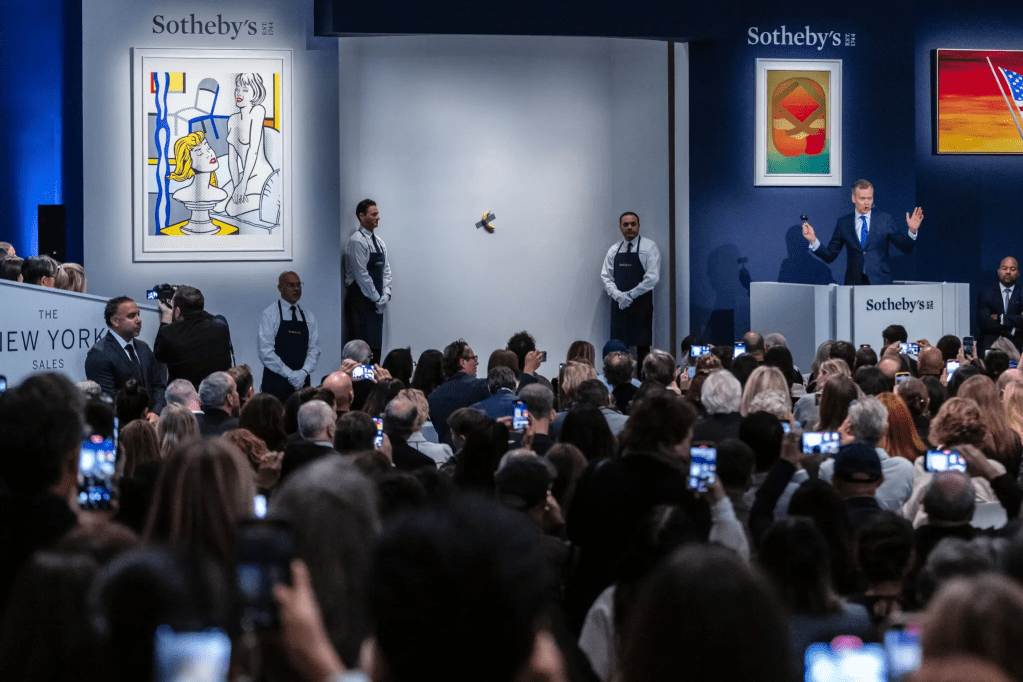
Bananas Foster

It’s Bananas!

By now 

you’ve heard

the absurd

story

of the crypto

bro

with too much

dough,

in all 

his glory,

created 

a story

about 

quite

an appetite

for art.

Entrepreneur 

Justin Sun

paid

6.2 million

for 

“Comedian”

at auction.

The conceptual

artwork

is an exceptional

quirk

in a world

that is 

rather quirky.

The banana

affixed

with duct tape

may be hard

to appreciate,

but it appreciated

exponentially.

Art is weird,

I’m sure 

you’d agree,

in the sense

that it makes

no sense

in dollars

and cents.

We’ve had 

a Campbell

Soup Can

and a urinal

called

“Fountain”,

provoking

opinion

and questioning

definition

of what is

art?

Art fosters

conversations,

not just

transactions,

about institutions,

obligations,

subjugations,

conventions,

and other 

inventions

of the mind

that get

left behind

or issues

not considered

otherwise.

In the case

of “Comedian”

the fruit

of the labor

of the artist

and vendor

(who sold

the banana

at his bodega)

will not receive

payment

from 

this sale.

But the statement

beyond the

“Comedian”

piece tale

was the ease

with which

the entrepreneur-

banana -connoisseur

ate it.

*image: nytimes.com/2024/11/20/arts/design/cattelan-banana-sothebys-auction.

Heat Wave

Desantis

cut

all grants

for arts

in Florida.

This is not

merely

the display

of Tom Delay

opposing

a nude

sculpture.

This is culture

war 

gone

nuclear.

Aside

from 

refuge

from the deluge

of the monstrosity

of absurd 

political

verbosity,

the arts

engage 

with less savage

rage

and elevate

hearts

and minds.

Thinking

critically

is critically

necessary,

and increasingly

lacking

in society.

Not merely

criticizing

the opposing

position,

but juxtaposing

division

for consideration

is the job

of the thoughtful

democratic

citizen.

Of course

arts 

are 

not exclusive

to democratic,

inclusive

societies.

All cultures

create

culturally 

great

works,

that work

to showcase

impressions,

expressions,

confessions,

obsessions

beyond

politics

or religion,

or economics

or any statistics.

Art 

is part

of being

human,

if only

to be

appreciated.

No reason

was given

as to what

had driven

Desantis

to defund

grants

for arts

across

the great

state

of Florida.

How about 

opera

in Tampa?

Or the Miami

City

Ballet?

Or the New

Word Symphony

or every gallery

from Tallahassee 

to The Keys?

More importantly,

these sacred

places 

not

for profit

benefit

the public—

educating,

celebrating,

debating,

and creating

connections

anew.

He won’t

undo

what he 

threatens

to,

despite

his defunding

veto.

It’s abundantly

clear

he’s sincere

about 

being a

rage 

machine.

He won’t

be outdone

by anyone

except

by himself.

Should

we be 

outraged

or disengaged?

Which

would be

most effective

against

the invective

and incentive

to be incensed

by the lack

of sense

and every 

pretense

and policy

to lash

back

against

culture

and history

since 1960?

Adding fuel

and heat

to compete

for VEEP

may be

a steep

conquest,

but my best

guess

is that

this wave

won’t 

save

him.

Heat

waves

have begun

not just

in the Sunshine

State. 

The first 

debate

will ignite

the fight

that will

get overheated

as MAGA

acolytes

on the right

like to 

make waves

and heat

things up.

The boiling

point

is the point;

to foil

any opposition

even if

the position

is to defund

all arts.

Don’t let

the heated

rhetoric

and waves

of crazy

keep you

lazy.

Support

the arts.

Buy and read

banned books.

Help women

access care

as needed.

Ignore the 

debate.

Help create

access

and accountability.

It’s your responsibility

in this 

heat wave.

The Madonna’s Face

Too tight,

too plump,

too weird,

to recognize

the well-known

mother of

invention

of herself

and style.

The changed

name

to ironically

subvert

The Virgin

overtly

with

underwear

as 

outerwear

and the 

semiotics

of the

feminine

as sex.

Baby voiced,

a female

Elvis,

the material

girl,

Marilyn 2.0,

(minus 

any innocence),

creating a verb

from the word

Vogue,

imposing

herself

constantly,

she demands

that the pop

culture

demands

her.

When all

is performance

(and monetized

of course),

why expect

aging

with grace?

Now

her face

consumes

this space

for discourse

about

youth,

and age,

relevance,

the feminine,

sex,

beauty,

legacy,

resistance,

performance,

and art.

She still

has the

ability

to miraculously

hold

the attention

of the masses

when 

attention

is a deficit—

now a cultural

disorder—

that

we obviously

need

to face. 

Patriot Acts

Happy Juneteenth! June 19, 1865 became known as Juneteenth, after the last of the slaves, those in Texas, were finally free. Although President Abraham Lincoln’s Emancipation Proclamation dates back to September 1862, and took effect the following January, the last of the states to finally emancipate slaves was Texas. In Texas, Juneteenth has  been an official state holiday since 1980.  There are currently 42 states and the District of Columbia which recognize Juneteenth as either a state holiday or special day of observance.

For many, reading The Emancipation Proclamation has become the traditional Juneteenth celebration. I hope that more Americans are considering the importance of Juneteenth. As we grapple with current definitions and interpretations of freedom and the challenges we must meet in today’s world, I often look to inspiring acts of patriotism from the world of the arts and culture. Creativity comes from freedom. American arts and culture is replete with what I like to call, “patriot acts”. These works, a tiny sampling here, are inspired and inspiring, and invite us to celebrate as well as create more “patriot acts”. I’m sure you will find many, many more to enjoy as well.

Ray Charles, America the Beautiful

http://youtu.be/1OTRRzSuWro

Aaron Copland, Fanfare for the Common Man

http://youtu.be/1TLV-4HJ41s

Dylan Smith
Trumpet BM Degree Recital
Eastman School of Music
April 3, 2010

“America”-West Side Story, (1961) Rita Moreno, George Chakiris

http://youtu.be/P50NXB3R4sc

Jasper Johns, Flag, 1954-55

http://youtu.be/9bWJt2hjBH0

Billy Holiday-Strange Fruit

http://youtu.be/Web007rzSOI

Joffrey: Mavericks of American Dance-American Masters

http://youtu.be/Jh_DpDXdvkA

Richie Havens-Freedom (Woodstock 1969)

http://youtu.be/W5aPBU34Fyk

reality shows

Reality shows us unimaginable forces. Tornados violently devastating towns, leveling neighborhoods for miles; teachers sheltering children from savage storms and at other times, from deranged  murderers; first responders rushing to save and assist victims; caregivers everywhere attending to needs great and small; love among family members and friends…..These are the images of reality that are continuously shown on our screens in the aftermath of dramatic events. They may be gripping events, and often seem unprecedented, yet it is the reality of the human responses that grips us. We may not know or understand all the facts that contribute to such absorbing incidents, but we have immediate and visceral responses to them. Sometimes those experiences are overwhelming or maddening, but often they are invitations to examine ourselves.

These events become the stuff of history, and therefore lessons. The truths of these events– the forces preceding the events and the forces of the events, as well as the aftermath, become the stuff of art.  In the meantime, we watch and listen to images of reality that force us to imagine what we would be; what we could be; what we should be.

On days like today, reality shows us the art of living.

Let’s Dance!

If our kids don’t replicate our suggestions, have they learned? Have we taught? As parents and educators, we attempt to nourish, protect, guide, acculturate, civilize, enrich and encourage. As Andrew Solomon writes in his masterful work Far From The Tree: Parents, Children, and the Search For Identity, “ There is no such thing as reproduction.” Parents produce offspring. The idea is that the product of the parents is a new organism. Even when the children resemble the adults, they always grow away from us. Andrew Solomon’s book is devoted to children who don’t resemble their parents, but the lessons are true for all. Teaching and parenting is not a matter of replication.

In many ways education (whether parent or teacher) is dance. We choreograph, composing a sequence of steps and moves. We design a form and motions. Educators/choreographers direct movement. Our kids are dancers. As learners, they (and we) employ codified movements in various contexts. Dance is a form of social interaction, emotional expression, and performance. Most importantly it is movement. If we consider  educating as guiding our kids’ (and our) movement  in the domains of social interaction, emotional expression and performance, rather than as a sculpture (or worse, a reproduction of a sculpture), then we can experience individual human rhythms and energies, and appreciate their distinctions and likenesses through their gestures.  We can move along with them.

Education is movement!  Let’s Dance!

Drawing Lessons

Sighs of relief. Jubilance. Gratitude and admiration for the excellence of first responders, medical personnel, citizens, neighbors, law enforcement at every level. It was an incredibly tumultuous and horrifying week that commenced with the Boston Marathon bombings, and culminated with the lockdown of Boston and the dramatic shootout and apprehension of the suspects,one dead, one wounded. Bostonians are able to resume their everyday lives, while all of us exhale and begin to consider what comes next.

Like any crisis, initial reactions can be visceral and harsh. When witnessing two young men, seemingly indifferent to human life, commit such horrifying acts, it is easy to want to exact revenge. Personally, I was thrilled that the younger brother was captured alive, and I hope that he will be able to provide actionable information. When many people reacted that they hoped he would die and/or suffer terribly, I thought about how incredibly difficult and rare it is to capture a terrorist or other violent criminal and not harm the perpetrator.

It reminds me of a truly remarkable historical event: the Israeli capture of Adolf Eichmann in Buenos Aires in 1960. That the Israelis were able to capture Eichmann and bring him to Jerusalem to stand trial for crimes against humanity as one of the organizers of The Holocaust, while many were recent survivors, is one of the most stunning examples of the capacity for human restraint and moral fortitude in the pursuit of justice. This is a lesson for humanity for the ages.

As we begin to seek answers to how the two Tsarnaev brothers became terrorists and what connections they may have had, much less how to deal with the surviving brother, I think it is also useful to consider lessons on drawing. We have been focusing thus far on “connecting the dots”, which of course gives us lines (or connecting line segments). We have photographic images, and other data that will help authorities connect the dots. When we draw, we sharpen our attention, and look for structure and proportion as well as various perspectives. Perhaps there is shading. Drawing is a process of refinement.

Drawing is not the same as form; it is a way of seeing form. (Edgar Degas)

The very act of drawing an object, however badly, swiftly takes the drawer from a woolly sense of what the object looks like to a precise awareness of its component parts and particularities. (Alain de Botton)

It is often said that Leonardo drew so well because he knew about things; it is truer to say that he knew about things because he drew so well. (Sir Kenneth Clark)

The mindset of drawing is one that is often cast aside, in favor of immediate images and instantaneous reaction. Drawing lessons may be as valuable as crowdsourced images though, if we are to enhance our understanding and possibilities for learning and improving.