Bananas Foster

It’s Bananas!

By now 

you’ve heard

the absurd

story

of the crypto

bro

with too much

dough,

in all 

his glory,

created 

a story

about 

quite

an appetite

for art.

Entrepreneur 

Justin Sun

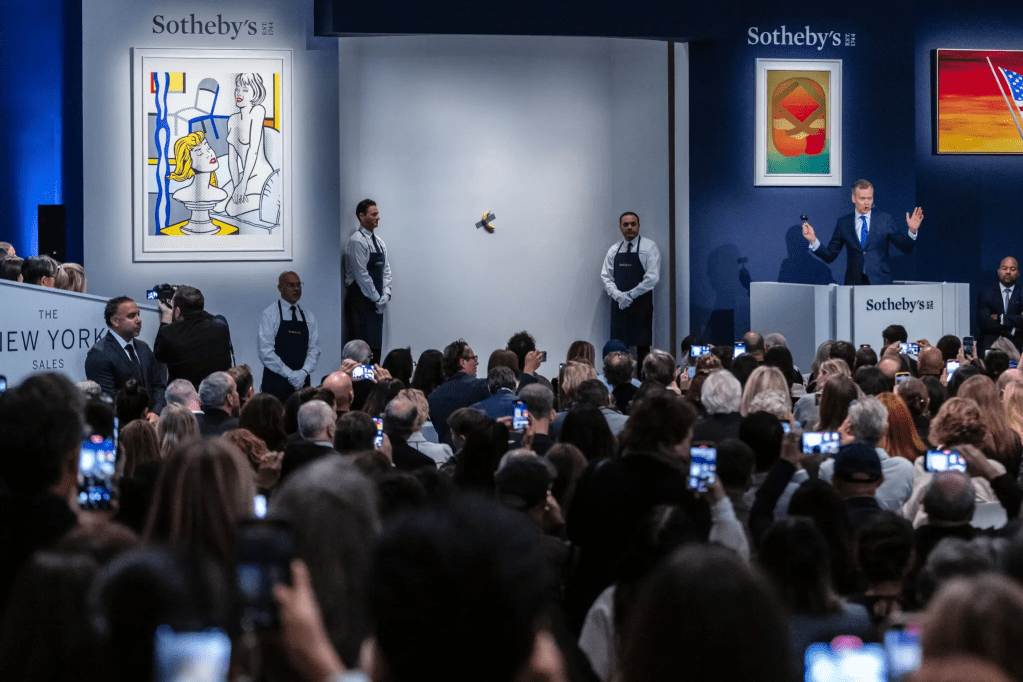
paid

6.2 million

for 

“Comedian”

at auction.

The conceptual

artwork

is an exceptional

quirk

in a world

that is 

rather quirky.

The banana

affixed

with duct tape

may be hard

to appreciate,

but it appreciated

exponentially.

Art is weird,

I’m sure 

you’d agree,

in the sense

that it makes

no sense

in dollars

and cents.

We’ve had 

a Campbell

Soup Can

and a urinal

called

“Fountain”,

provoking

opinion

and questioning

definition

of what is

art?

Art fosters

conversations,

not just

transactions,

about institutions,

obligations,

subjugations,

conventions,

and other 

inventions

of the mind

that get

left behind

or issues

not considered

otherwise.

In the case

of “Comedian”

the fruit

of the labor

of the artist

and vendor

(who sold

the banana

at his bodega)

will not receive

payment

from 

this sale.

But the statement

beyond the

“Comedian”

piece tale

was the ease

with which

the entrepreneur-

banana -connoisseur

ate it.

*image: nytimes.com/2024/11/20/arts/design/cattelan-banana-sothebys-auction.

Born to Run

Moment of Zen: Bruce performing Born to Run, as Jon Stewart’s send off. A masterful choice especially on the night of the first (2) Republican Debate(s).

Jon Stewart had a terrific run. Serious and silly; satirical and authentic; funny and forceful; generous and humble. Hard working, self-deprecating, patriotic, principled, and very smart. A mensch. A very funny mensch.

Then there were those who thought they were born to run— running FOR President of the United States. It has become a horrible marathon, one that for the first time, I am running from. The qualities I would want in the President, are not evident to me. It’s more like The Running of the Bulls, over and over and over for over a year.

We somehow agreed that running a race was a litmus test for governance. We’ve seen that governance is more art than sport, and the race….well, that’s just bad sport. Meanwhile, politics has become sport—blood sport— and the champion must then govern, which may mean veering off track. Politics has become about disabling governing, creating hurdles and throwing those dense shot puts (putting shots?), adding velocity with spin. It makes running the country almost impossible.

Even when I feel despair and can’t see the track, or when I so easily feel overwhelmed and I feel stuck—even paralyzed—or when I run from that which I find objectionable, I know I have to get back on track. Whether it’s the state of politics or my own state of mind —even from nonsense, I sometimes feel like I’m running on empty.

It’s so easy to feel that time is running out. Environmental concerns and climate change can feel overwhelming. And,on this 70th anniversary of the US dropping two atomic bombs on Hiroshima and Nagasaki, we are reminded of the very dangerous world we’re in. Those who oppose the Iran Deal on nuclear weapons, fear the worst. It is terrifying. Others believe that negotiations and deals are preferable ways to managing the dangers. It’s so difficult to trust and let things (much less people) run their course.

We were born to run. We were born to go forward. We were born to have a good run—to make it a good run. We can see the running to and the running from, much less the running for and the running against. At this point, I want to make it a good run. Some remind us of the ways to keep things up and running—with integrity, love, work, joy, art, music, dance, humor. I needed that Moment of Zen last night: the celebration of a great run, and the way to stay up and running and to go forward.

Script

Cursive!… Foiled again!

Among the seemingly perennial issues in education, there is a resurgence in the concern over no longer teaching handwriting (i.e.cursive English). Given that education is one of those paradoxical institutions that on the one hand has as its aim to prepare for the future, it is also, more often than not, conserving the past. The present state of education is one that generally feels like it is behind the present moment in the rest of our culture. K-12 education tends to play catch-up, rather than lead the culture. As schools across the country are debating and implementing the new Common Core Standards, many teachers have suggested that something’s got to go, and that something will be handwriting, as keyboarding has more  cultural relevance.

Many lament the notion that students may no longer learn cursive. For some, it is a cultural  loss for the next generation(s). In some scientific and educational communities, some point to studies suggesting an academic advantage for elementary students who learn cursive over those who don’t. Is learning cursive a necessity today?

With limited time and money,and mandated testing, many teachers have suggested dropping handwriting lessons from the curriculum. Certainly keyboarding is a necessity in everyday life in ways that handwriting is no longer requisite. Of course there are people who never mastered penmanship and were/are quite intelligent and high achieving. Physicians are not the only ones who can’t write a legible script in script. For those  who are dysgraphic, or perhaps less severely, just not good at handwriting, keyboarding is a gift, and can transform their written communication and ability to achieve. However, one of the more interesting arguments for teaching cursive, is that in practicing the smooth movements connecting letters, mental connections are also made, that are not replicated in keyboarding. The argument continues that even learning to read cursive writing advances certain mental capacities for making connections, as we see and interpret connected symbols.

What may have begun as picking up a twig or a rock and etching symbols in dirt or on caves, progressed into handwriting. With the quill and ink, cursive became more developed as the writing method was employed to limit spills and breakage. Of course, in our age, the keyboard is the most expedient form of non-vocal communication. The most obvious sacrifice in abandoning learning cursive is the individuality–the signature.Even learning the uniformity of the cursive alphabet, handwriting is a uniquely individual enterprise. It can be honed, but handwriting is still not quite anonymous. It’s personalized.

Many cling to teaching handwriting as part of a cultural heritage. Some regard penmanship as an art form. Others tout the importance of fine motor skill development as well as it’s connection to brain development. The detractors focus on the imperative of teaching the most necessary skills for the moment, and handwriting seems like a cultural remnant–irrelevant to the tasks of the future.

It seems to me that the arguments for and against teaching cursive are essentially from a tired script. Many debates in education seem to be either/or in nature. Teaching cursive is slow, and there are so many other things to test. But if teaching cursive can help develop both left and right hemispheres of the brain and their connectivity, then maybe we need to look at other ways to teach and practice writing script. We don’t need to teach cursive just because it was our script. Handwriting may never be used the way it was prior to this moment in history. However, like science, math, history, language, physical education and art, it is a way of seeing and doing that creates connections, and making connections is essential to creativity. Perhaps rethinking our script about teaching script as a remnant of the past, to a practice of creativity, makes handwriting the future.
Art Forms

I have no particular talent. I can carry a tune, so I can sing along, but my voice is not particularly interesting or especially pleasing. Likewise, I can enjoy dancing, and have some rhythm, but my ability to retain choreography is lacking. Even basic party crowd pleasers can be awkward for me. I’m a lousy photographer. Actually, I’m no photographer at all. At least I have a phone. I can’t paint or draw or sculpt. I took piano lessons for a few years as a kid, and can’t play at all. I didn’t dare try any other instruments. I enjoyed being part of stage productions, but not because I was any thespian. I just had fun despite my lack of talent.

For me,creating art in any variety, was an alien experience. What I heard musically, I couldn’t reproduce (except in an ordinary voice, best blended among other voices and instruments). What I wanted to capture with a camera, rarely appeared as I saw it. Dance as rhythmic movement to music was always a good diversion, but memorizing steps was not natural for me. There seemed to be a disconnect between my memory and my feet. Likewise with the piano: I could hear the way the music should be, but my fingers couldn’t reproduce it. And the graphic arts eluded me entirely. Yet, I have always gravitated to the arts. The arts may not have been my  own expression, but learning to appreciate the arts and how to see art, hear music, and how the body can move, has shaped my entire life.

Like language, arts reflect cultural attitudes as well as manifest individual expression. The more one learns the grammar, the more one can access and comprehend and be enriched. I may lack certain abilities necessary for producing my own art form, but I have learned how to see and hear–how to appreciate, and that appreciation of all forms of art and their connections to all of life has enhanced my life experience.

As an educator, I can not underscore enough the power and significance of developing an appreciation for the arts. It is part of literacy. Like language, the arts connect ideas with expression. They are not peripheral. Not everyone needs to have artistic talent, but the arts are necessary for everyone. We need not be practitioners, but we do need to cultivate our appreciation and train our senses. Art is a human instinct. It drives culture. Art forms.

culture of education/education of Culture

Throughout my years as an educator, I have infused my lessons with works of art–from literature to paintings, to plays and movies, as well as dance and music. I don’t really know how to teach english or history or even government (remember civics???) without drawing upon Cultural  examples.  Our kids are often taught in schools that have relinquished the arts and Culture to nonschool life. How can we say that we are educating without Culture?  How can we outsource the arts; extricate it from formal schooling? To be educated is to be Cultured. To be Cultured is to be educated. When the arts are available as an extra-curricular option, or only to the wealthiest, we deprive our culture of excellence and opportunity.  I’m thrilled that there are so many out-of -school and extracurricular opportunities for students to engage in an art form, but we seem to have lost the connectivity that the arts inherently provide. We have also separated the artist from the teacher–except in the cases of the art or music, or the even rarer dance teacher. We employ school teachers who are often stifled and who must be managers first and foremost. They are often not even creators of their own curricula and must adhere to prescribed lessons and assessments. Creativity must return to education, and cultural centers must also play a greater role in educating our communities.

This is the beginning of a broader conversation. I invite readers to share ideas and practices that bring together the arts and education beyond the basics and beyond the early years, after which,  subjects become more segmented, and students’ lives are more rigid.  Educators, parents, students, artists, musicians, dancers, civic leaders and laypeople…..please share creative ideas.